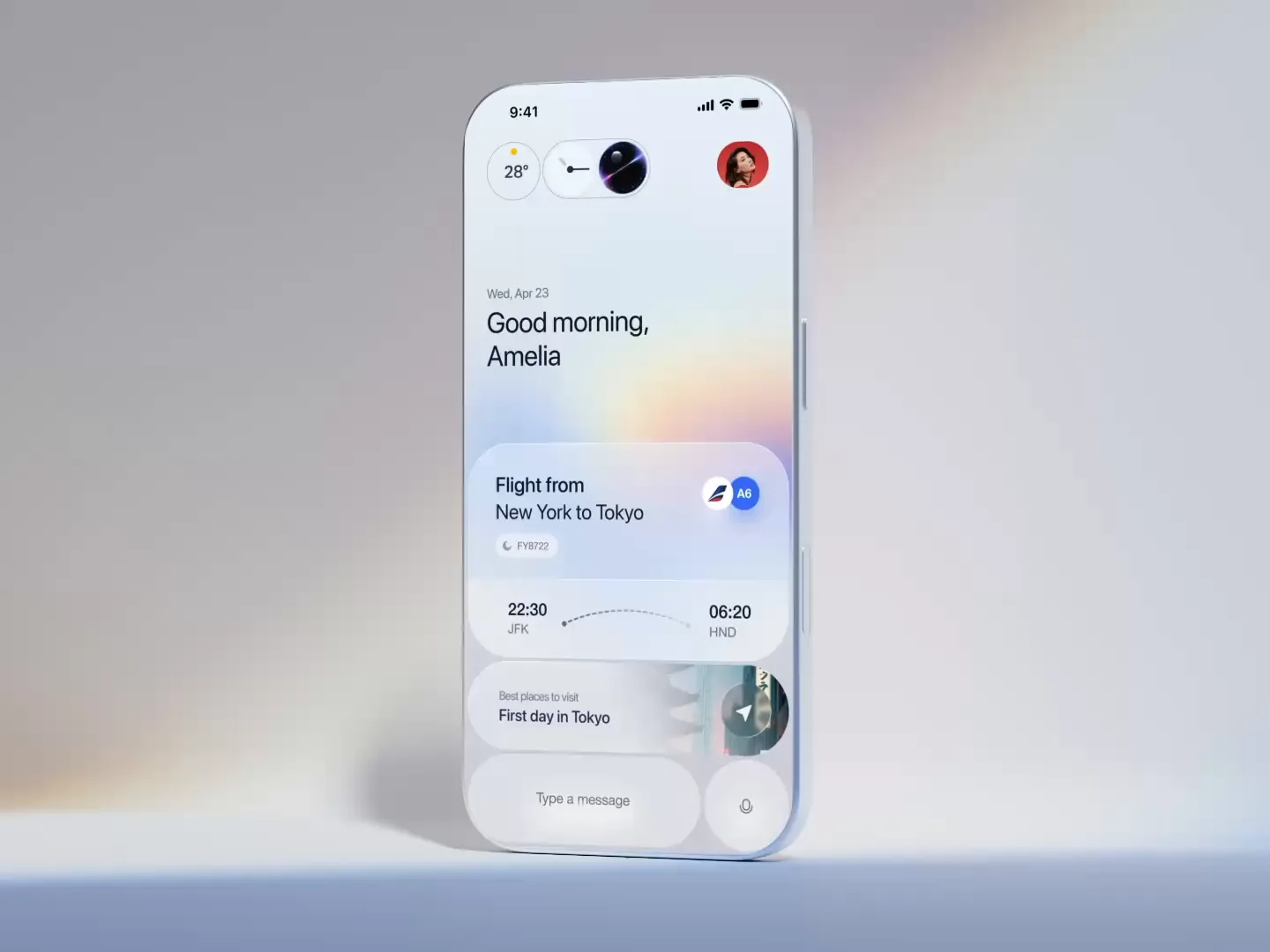
Listening, thinking, speaking: body language for an assistant without a body

In 1944 Fritz Heider and Marianne Simmel showed people a short film of two triangles and a circle moving around a rectangle. Almost everyone told it back as a story, complete with characters, motives and a chase.1 The shapes had no faces. Motion was enough. An AI assistant without a face is betting everything on that effect. Its whole body is one shape and the way it moves, and with that it has to hold up its end of a conversation.
Why a shape, and not a face
A face makes promises an assistant can't keep. Masahiro Mori noticed back in 1970 that a likeness that's almost human, but not quite, turns affinity into unease.2 An abstract object dodges the comparison and can still show intention through how it moves. Heider and Simmel's triangles had nothing else going for them, and people still gave them motives.
Whatever the shape turns out to be, keep it one shape. For Honda's assistant, a thin spinning ring of colored light covers loading, listening and talking, and it's slim enough to sit over a map without hiding the road. The assistant ring states made for three AI and automotive products use one circle that sleeps, wakes, listens and fills with light. For Rokid, the ring never spins at all. It wobbles and ripples as if something were moving inside, and across every state the outline stays put. Only the motion changes.
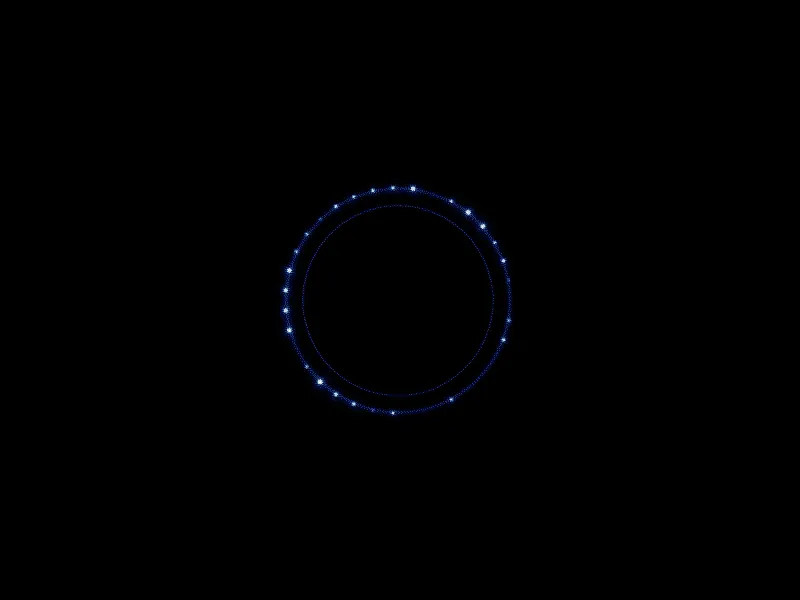
The shape carries identity and the motion carries state. Learn the symbol once and it works everywhere: as an icon, as a state, as a brand mark. A voice assistant identity does it with a single soft sphere, where color drifts around inside as the assistant talks and listens.
A conversation has a rhythm
Conversation runs on turn-taking, and it's far more precise than it feels from the inside. Harvey Sacks, Emanuel Schegloff and Gail Jefferson mapped it as a system of small signals that tell each speaker when to go and when to yield.3 It's quick, too. When Tanya Stivers and her colleagues compared ten languages, they found the same habit in every one of them: people avoid talking over each other and keep the gap between turns tiny, usually a few hundred milliseconds.4
A language model needs longer than that just to get started. That's what assistant states are really for. They let a machine keep its place in a human rhythm it can't match. Listening holds the floor open for you. Thinking claims the turn before there's anything to say. Speaking takes it, and idle hands the floor back.
Listening is a back channel
Victor Yngve had a name for the little signals listeners send while someone else is talking, the nods and the mm-hms. He called it the back channel.5 Herbert Clark and Susan Brennan later showed how much conversation leans on those signals, a steady trickle of evidence that what you said is landing.6 A listening state is the machine's back channel, and it has to show up before any text does.
For Pryon, a fine ribbon of lines runs through a glass sphere and follows the voice. An early study for Natural AI pulls particles of violet light into a thin line that swells into a mesh, rising with the speaker's voice. Neither one needs a microphone icon. Listening should also leave the rest of the screen alone. In voice input for Natural search, a small shader symbol shifts with your voice while search stays exactly where it was on the home screen.

Thinking: show the work
A spinner tells you something is happening. It doesn't tell you what. Ryan Buell and Michael Norton found that people valued a service more when they could watch the work being done for them, even when it meant waiting longer. They called it the labor illusion.7 People will put up with a wait. What they resent is an empty one. A waiter who says the kitchen is on it buys a lot of patience; a waiter who vanishes buys none.
In thinking mode in Natural OS, a flight request gets assembled on screen in visible stages. For Imagica, an iridescent sphere turns with a cut through its middle, and that one object stands in for every wait in the product. In one assistant sphere, the color inside folds into a turning loop while the answer is being prepared. It's kept deliberately different from listening, so you can tell being heard apart from being worked on.

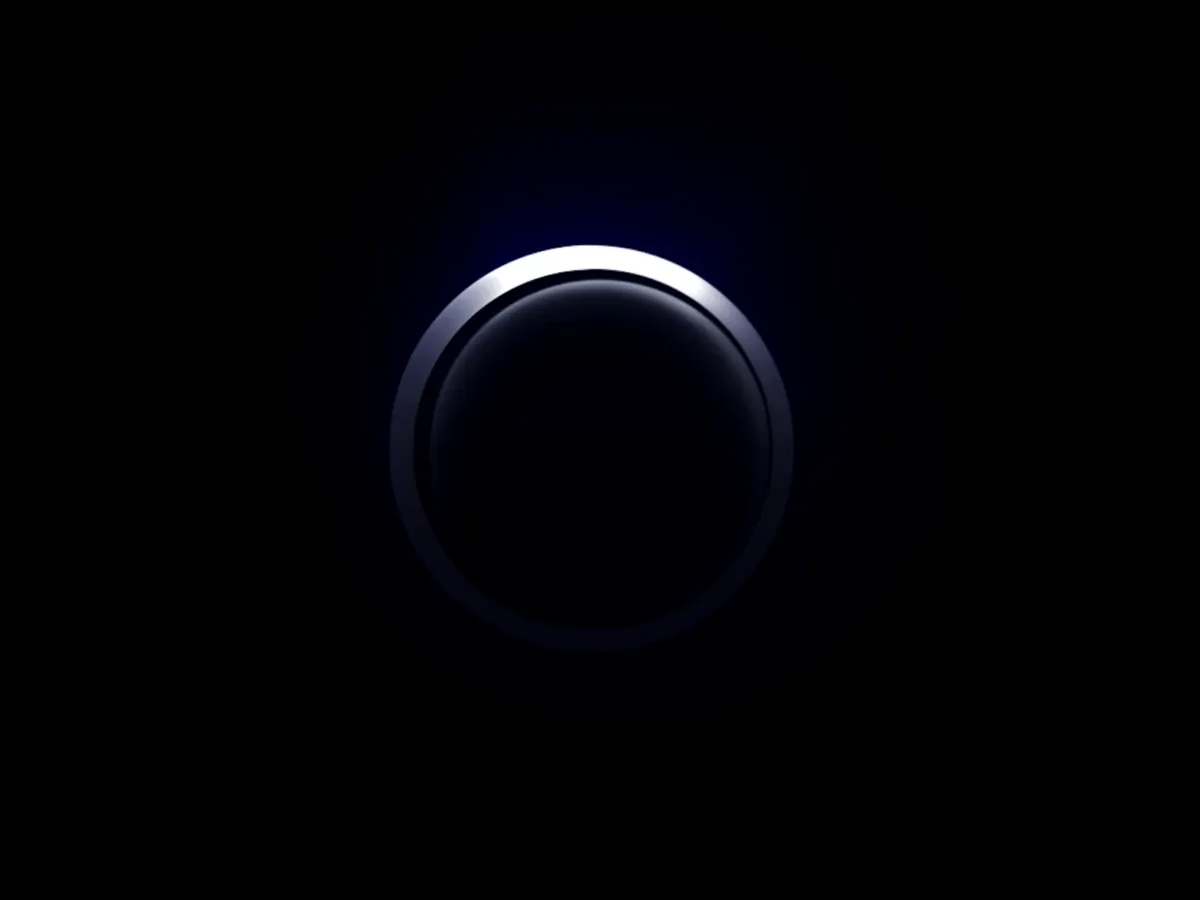
It also helps to hold color back while the model is working. In a loader for a generative AI interface, concentric rings pulse in black and white around a dark center, a bit like a lens finding focus, so the wait never competes with the answer that comes after it.
Speaking: the voice moves through the object
When the assistant talks, motion can carry the voice with no waveform and no captions. In one speaking state, color moves through a glass sphere in waves as the words come out, and the reflections on its surface keep it feeling like an object in the room rather than a sticker on the screen. On the philosophy page for Natural OS, the system's voice is a single horizontal line of light that waves when the AI talks.

A waveform is a picture of sound, parked next to whoever is talking. When the object itself moves with the voice, the object is the one talking.
Idle: the periphery
Most of an assistant's life is spent waiting. Mark Weiser and John Seely Brown described calm technology as technology that uses both the center and the periphery of our attention and moves easily between the two.8 Idle lives in the periphery. The Natural AI idle state keeps a slow breath of color at the edge of the sphere while nobody's talking. A symbol for a health AI breathes in and out at a pace borrowed from relaxation exercises.
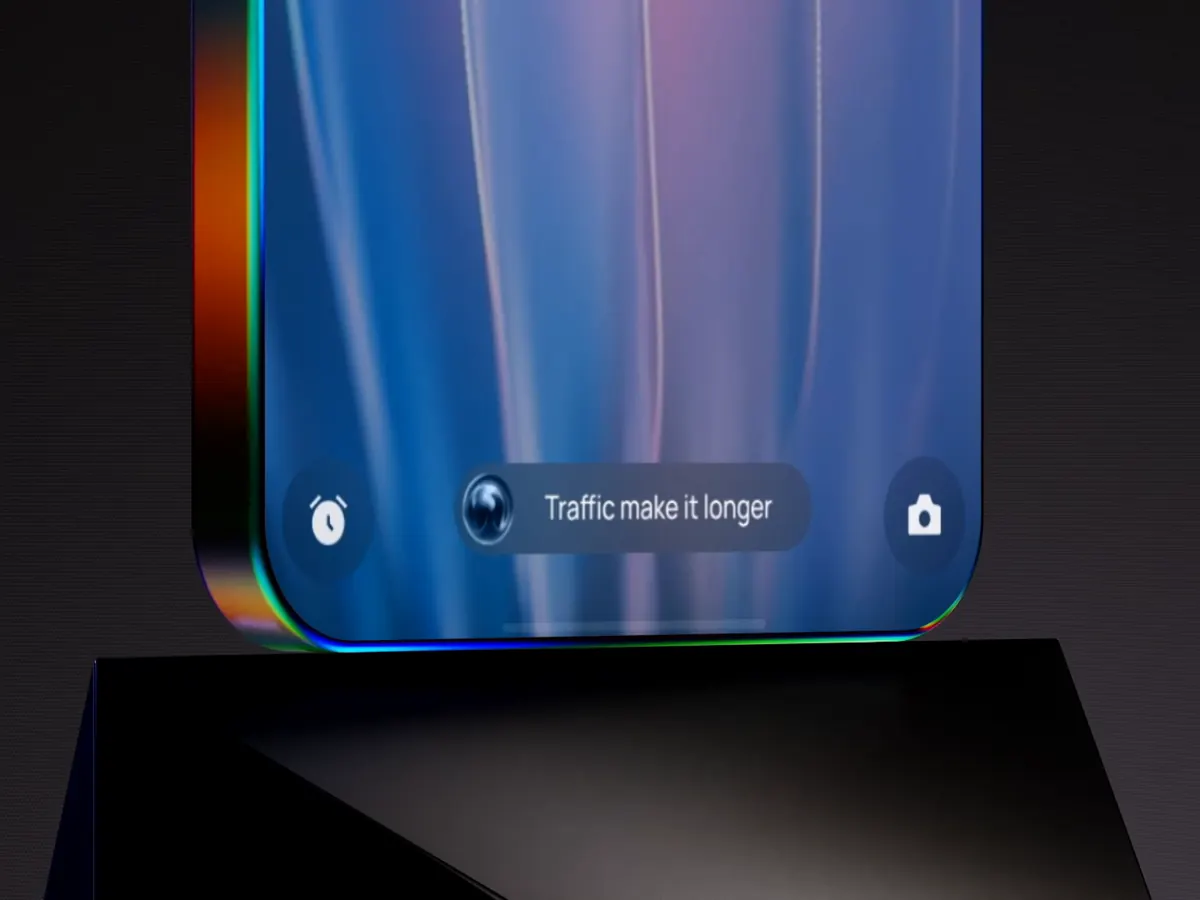
Coming forward from the periphery should be just as quiet. In notifications for Natural OS, news like traffic making your trip longer arrives as colored light running along the edge of the phone, plus a single line of text near the bottom. The rest of the screen stays free.
On glasses and in cars
Context changes the rules. A see-through display can only add light to the world, so black is simply transparent. The loader for Rokid's augmented reality glasses is a thin ring of light turning in empty space, and it never hides the world behind it.
In a car, the budget is one glance. Guidelines from the US National Highway Traffic Safety Administration ask that tasks on in-car screens need glances off the road of no more than two seconds each.9 A state has to be readable inside that window. In an automotive HMI, a ring of blue particles gathers, pulses and dissolves between states, which tells the driver the system is working without a spinner or a word of text.
A short checklist
- One object for every state. The shape is who it is; the motion is what it's doing.
- Listening reacts within the rhythm of the conversation, before any text.
- Thinking shows what kind of work is going on, and is never a spinner.
- Speaking moves through the object, not next to it as a waveform.
- Idle stays in the periphery and comes forward quietly.
- On see-through displays, draw only with light. In a car, be readable in a glance.
Open questions
- Assistants have states for listening, thinking and speaking, and almost nothing for doubt. What does uncertainty look like in a shape?
- How does an assistant show it's talking to the person across the table, and not to its owner?
- As answers start faster, will thinking stay a state of its own, or melt into the way it speaks?
References
- Heider, F. and Simmel, M. (1944). An experimental study of apparent behavior. The American Journal of Psychology, 57(2), 243-259.
- Mori, M. (1970). Bukimi no tani [The uncanny valley]. Energy, 7(4), 33-35. Trans. K. F. MacDorman and N. Kageki, IEEE Robotics and Automation Magazine, 19(2), 98-100, 2012.
- Sacks, H., Schegloff, E. A. and Jefferson, G. (1974). A simplest systematics for the organization of turn-taking for conversation. Language, 50(4), 696-735.
- Stivers, T. et al. (2009). Universals and cultural variation in turn-taking in conversation. Proceedings of the National Academy of Sciences, 106(26), 10587-10592.
- Yngve, V. H. (1970). On getting a word in edgewise. Papers from the Sixth Regional Meeting of the Chicago Linguistic Society, 567-578.
- Clark, H. H. and Brennan, S. E. (1991). Grounding in communication. In L. B. Resnick, J. M. Levine and S. D. Teasley (Eds.), Perspectives on Socially Shared Cognition (pp. 127-149). American Psychological Association.
- Buell, R. W. and Norton, M. I. (2011). The labor illusion: how operational transparency increases perceived value. Management Science, 57(9), 1564-1579.
- Weiser, M. and Brown, J. S. (1996). Designing calm technology. PowerGrid Journal, 1(1).
- National Highway Traffic Safety Administration (2013). Visual-Manual NHTSA Driver Distraction Guidelines for In-Vehicle Electronic Devices. US Department of Transportation.