The autonomy contract: what an AI that acts for you owes you

When software only answered questions, you could judge it by how it looked. Software that books, pays and sends things for you has to be judged by what it owes you. The four terms below come from a talk I give called The Autonomy Contract. None of them is new, strictly speaking. Each one answers a problem that people who studied automation wrote down decades before anyone built an AI agent.
Why autonomy needs terms
Delegating isn't new. What's new is handing work to something you can't fully inspect and that moves faster than you can watch. Pilots and power-plant operators hit this wall first. In 1983 Lisanne Bainbridge wrote about the ironies of automation: the more a system automates, the more its rare failures land on a human operator, and the less practice that operator gets at handling them.1 It's a short paper, and a slightly uncomfortable one to read today.
Raja Parasuraman and Victor Riley later sorted the ways people and automation go wrong. Misuse is leaning on a system that hasn't earned it. Disuse is ignoring one that has.2 John Lee and Katrina See named the healthy middle calibrated trust: you rely on a system exactly as much as it deserves.3
An AI agent inherits every one of these problems. Only now the operator is anyone with a phone, and nobody trained them. Autonomy without terms is not convenience. It is exposure. Capability is engineering; consent is design.
So the screen gets a new job. It used to be where the work happened. With agents it's closer to a receipt: what was done, what the system knows, what it still needs from you. And the receipt is how trust gets calibrated. People keep checking it until the system has earned their reliance, and then one day they just stop. The screen fades when people stop needing to check, not when AI gets smarter.
1. It may prepare, remember and recommend
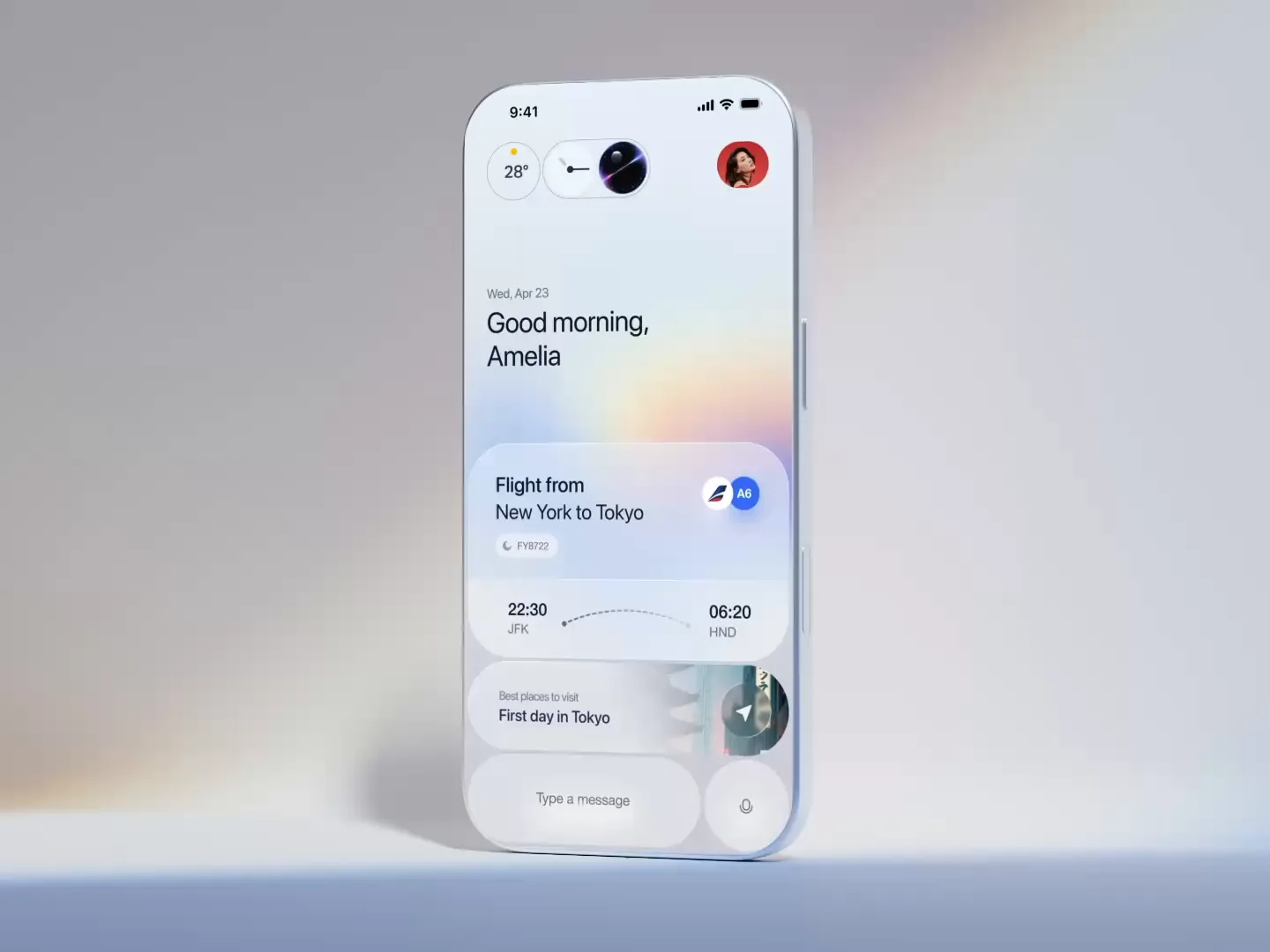
The first term is a license. An agent can get things ready before you ask, hold on to what you tell it, and suggest what to do next. All three can be undone, and all three stay between you and the agent. Nothing here moves money, sends a message or changes what somebody else sees. On the Natural AI Phone launcher, cards turn up as the day unfolds: a trip shortly before you travel, a bit of help right at the moment you need it.

Remembering is the one I'd handle with gloves. Andy Clark and David Chalmers argued that a notebook can count as part of someone's mind if it's always there, easy to reach, trusted without a second thought, and filled with things the person once agreed to.4 An agent's memory passes the first three tests without trying. It fails the fourth the moment it writes down something about you that you never confirmed. North Star, in the Natural AI app, starts from the opposite end. Before the assistant plans anything, it asks what you actually want to achieve, and keeps your answer as a fixed point to steer by.
2. It must show what it knows, what left the device and what changed
The second term turns memory into something you can sign off on. Mind Space, the memory and focus screen in Natural AI, lays out what the agent knows about your plans and interests as cards you can read, out in the open instead of buried somewhere in the model. A memory you can read, you can keep, fix or throw away. One you can't read isn't really yours. It's a file somebody keeps about you.
Same goes for reasoning, and for whose interests are in the room. In thinking mode, an answer is built on screen in stages you can follow before anything happens. During onboarding for Natural AI, the assistant owns up to something most products would rather hide: the skills it picked up carry a lot of sponsored content. Then it offers to strip all of it out with a single No Ads mode button. An agent that tells you whose interests are shaping its answers gives you something solid to calibrate against.

The last line on the receipt is what changed. On an agentic home screen for the Natural phone, a goal like dinner with your wife shows up as a card with the step in progress (finding the cuisine and the place) and the step after it (booking the table), so you can stop or change the plan at any point.
3. It must ask before anything irreversible, sensitive or affecting another person
Eric Horvitz framed acting versus asking as a decision under uncertainty: an agent should act when the expected value of acting beats the cost of interrupting you, given how sure it is about what you want.5 Fair, as far as it goes. But confidence can't carry that decision alone. A model can be 99 percent sure and still get one payment in a hundred wrong. If that payment can't be reversed, the single mistake outweighs ninety-nine small conveniences. Asking would have cost you a second.
Confidence belongs to the model. Reversibility belongs to the world. So the line is drawn by consequence. Irreversible means you can't take it back: a payment, a message that's already gone. Sensitive means health, money or where you are. Affecting another person means somebody who never agreed to the agent's terms. Every device has two users, the one who bought it and the one who did not, and the person across the table agreed to nothing.
Asking doesn't have to be slow. In the private mode onboarding for Natural, you're offered incognito across all the apps Natural works with, which keeps your activity and payment details private. One tap turns it on. Another skips it. Consent at the speed of a glance is the next discipline.
4. It must repair its mistakes, visibly
Agents will get things wrong. Count on it. This term is about what happens next: the mistake is shown, it gets fixed, and the fix appears in the same place you'd go to check what was done.
A quiet repair leaves two wrong impressions behind. You don't know the system failed, and you don't know it can recover. Both throw trust off, because people calibrate how much they rely on something by watching what it does.3 A visible repair is evidence both ways: this is how it breaks, and this is how it comes back. It also takes some of the sting out of Bainbridge's irony. If you've seen the failures and the fixes, you carry a working picture of the system around in your head, and you're ready on the rare day it needs you.
New jobs for designers
Each of these terms creates design work that simply didn't exist when software sat there waiting for taps.
- Consent designer: designs permission at the speed of a glance.
- Silence designer: decides what never needs to reach you.
- Latency designer: shapes the seconds between intent and result.
- Return designer: designs the moment you come back to what was done while you were away.
- Purpose designer: writes what an agent is for, and what it must refuse.
- Taste director: keeps one of two hundred, and knows why.
Open questions
- How should an agent's memory fade? People forget and notebooks don't. A real extension of the mind might need to forget on purpose.
- What does a receipt look like for something that took a thousand steps?
- How does the person across the table say yes or no, at the speed of a glance?
The Autonomy Contract is given as a 30-minute talk; the other talks are on Events. Speaking and media: gleb@milkinside.com.
References
- Bainbridge, L. (1983). Ironies of automation. Automatica, 19(6), 775-779.
- Parasuraman, R. and Riley, V. (1997). Humans and automation: use, misuse, disuse, abuse. Human Factors, 39(2), 230-253.
- Lee, J. D. and See, K. A. (2004). Trust in automation: designing for appropriate reliance. Human Factors, 46(1), 50-80.
- Clark, A. and Chalmers, D. (1998). The extended mind. Analysis, 58(1), 7-19.
- Horvitz, E. (1999). Principles of mixed-initiative user interfaces. Proceedings of the SIGCHI Conference on Human Factors in Computing Systems (CHI '99), 159-166.